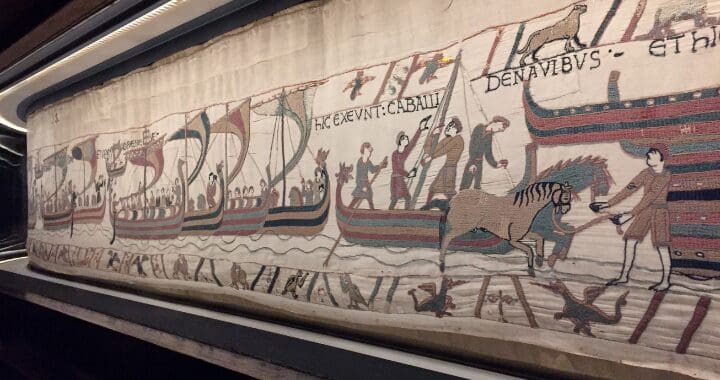
Earlier this month, I was fortunate to attend the British Museum’s much-awaited Bayeux Tapestry exhibition on opening day. The Bayeux Tapestry is easily the most recognizable artwork in English history, detailing the events leading to the Norman Conquest in 1066 at the Battle of Hastings. In what many are calling the UK’s exhibition of the century, this exhibition marks the first time the Bayeux Tapestry has ever been publicly displayed in the UK, nearly a millennium after its creation. The tapestry (which is actually an embroidery) recently arrived at the British Museum on loan from the Bayeux Museum in Normandy, where it will remain on display until July 2027, while the French museum undergoes renovations.
The Bayeux Tapestry’s Impact
Initial reviews from art critics and viewers alike have been overwhelmingly positive (with the only complaints regarding the ticket prices, scarcity akin to obtaining Taylor Swift tickets, and queues lasting hours!). The exhibition has ignited a renewed interest in medieval history across wide demographics, attracting (even more) visitors from around the world and taking the internet by storm. Despite the niche subject matter and the tapestry’s age of nearly a thousand years, its appeal has proven to be virtually universal. The Bayeux Tapestry remains relevant and fresh as ever as a world-class artwork, with a well-earned place on the UNESCO Memory of the World International Register.

Valuing the “Priceless”
The cultural, educational, and even political impact of the British Museum’s Bayeux Tapestry exhibition is difficult to quantify. Many have since asked how art valuers would determine the value of a “priceless” piece of world heritage such as the Bayeux Tapestry. There are very few artworks of this level of fame in the world, such as da Vinci’s Mona Lisa or Michelangelo’s David, among a small handful of others held in world-class museums. For this exhibition, the British government insured the tapestry for 800 million GBP under the Government Indemnity Scheme, a program distinct from commercial insurance, which would have been even more expensive. The intricacies of how to insure a “priceless” and unique artwork such as the Bayeux Tapestry have been discussed at length in the media and do not apply to the majority of art collectors. However, when we at Doerr Dallas value unusually unique artworks in our clients’ collections, we utilize many of the same valuation principles that would be relevant when valuing an object such as the Bayeux Tapestry.

How Valuers Approach Unique Objects
When a valuer assesses your objects, whether for insurance purposes or to determine the fair market value, one of the core steps in our methodological process is searching the market for comparable items. Ideally, we are looking for comparables with matching characteristics, such as the artist, subject matter, level of craftsmanship, dimensions, condition, provenance, rarity, cultural significance, etc. For cases such as the Bayeux Tapestry, there are no direct comparables because the artwork is utterly unique (even comparable copies are difficult to find, with only one known complete replica, on display at the University of Georgia).
When there are no direct comparables available, valuers instead search within what we call “parallel markets”, prioritizing one or a handful of characteristics that are the most integral to an item’s value. The methodology for valuing the Bayeux Tapestry for insurance was not publicly disclosed, but based on the valuation principles we use to value more traditional collections, the most important characteristics for the tapestry likely included rarity, cultural significance, age, size, condition, and the insurance values of objects of similar significance held in comparable museums. Because every item and market is different, trained valuers do not employ a boilerplate approach to valuing unique items. A valuer’s experience and expertise help them choose the correct characteristics to prioritize and which parallel markets to assess in the valuation process. As a specialist in Asian antiques, I often prioritize rarity, provenance, and level of craftsmanship when searching parallel markets, but for a specialist in a different area, the types of characteristics and parallel markets may warrant entirely different methodologies.
This is an important example of why it is essential not to rely on AI for your valuations and instead engage a qualified valuer, such as our team at Doerr Dallas, because AI chatbots are not equipped to assess the nuances of even simple valuation tasks, let alone the complex valuation methodologies necessary to accurately value a unique work of art, whether it is the Bayeux Tapestry or an item held in the collection of one of our clients. This is also why it is essential for clients to provide us with as much information and documentation about your collections as possible at the beginning of the project, as some of this may be essential information in solving the puzzle of valuing a unique object.
If you don’t have tickets for the British Museum exhibition yet, be sure to keep an eye out for 2027 releases in October, as the exhibition has already sold out for the remainder of 2026. If the Bayeux Tapestry leaves you curious about more early English history, English Heritage site 1066 Battle of Hastings, Abbey and Battlefield is not to be missed, where visitors can walk through the fields of the battle site themselves and learn about the battle strategies, politics, and culture of the Norman Conquest, or even watch a live battle reenactment!