

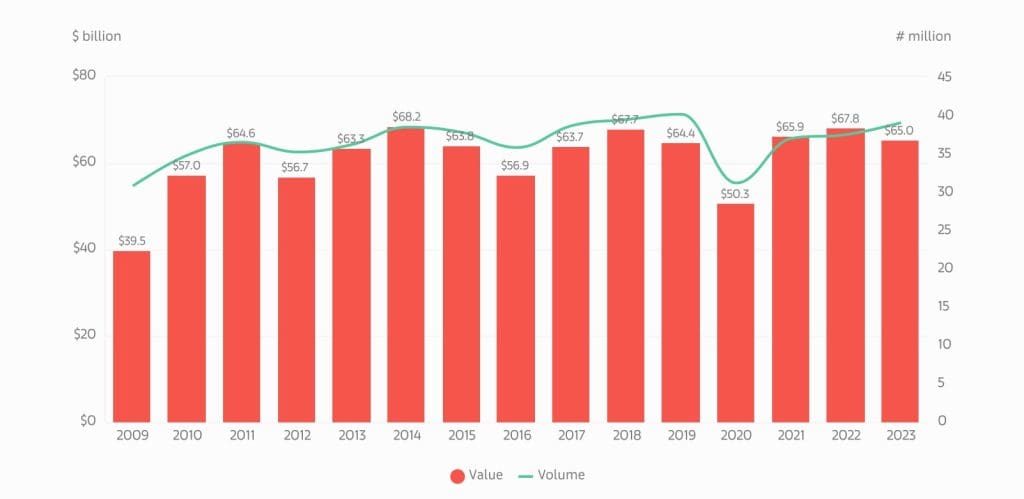

2023 in the Art Market has been one of readjustment and realignment, but thankfully not collapse – a market correction rather than the much talked about free-fall of the market.
2022 ended on a fever pitch high, with a slew of blockbuster auctions and record-breaking auctions – the Macklowe Collection brought in $922m at Sotheby’s, the Anne Bass Collection achieved $383m at Christie’s, and the Paul Allen Collection achieving just over $1.6b also at Christie’s – taking the honour of being the first sale to top the billion-dollar mark.

Yet even as these records were being made, savvy pundits predicted a gloomier future for 2023 which turned out to be true.
Surprisingly, it was the top end of the market, with its superior quality and strong provenance, that failed to deliver the goods in 2023. It was badly hit in comparison to 2022, generating a little more than half the sales value compared to the previous years. In 2023, the most expensive artworks at auction paled in comparison to last year. The top 100 lots at auction this year totalled $2.4 billion, compared to $4.1 billion in 2022.
Why is this? Experts cite higher interest rates, continued inflations, and the ongoing turbulence in the financial markets as reason for the dip – but economic jitters aren’t the only factor at play. The continuing war in Ukraine continues to negatively effect the global economy, as no doubt, the current Israeli/Palestinian war will too. Added to this, the post-pandemic exuberance of spending that fuelled the market in late 2021 and 2022 has certainly levelled off.
Across every category in the market, sales contracted in 2023 – but some were hit harder than others.
All of this has had a negative effect on the market – spooking all but the motivated seller from consigning their treasures to an increasingly unpredictable and volatile market. Just like the property market, why would you sell in a falling market? As a result, the number of works coming to auction hit a three-year low in the year’s first five months, and the contraction is most extreme on the high end. The May marquee auctions of Modern and Contemporary art in New York were noticeably underwhelming. The three main auction houses grossed an aggregate $1.4bn (with fees), significantly lower than the $2.5bn achieved the previous May, according to data provided by Pi-eX (the Londonbased art auction analysis firm).
Similarly, the up until now extra-hot, speculative/flip led market for young ultra contemporary artists also cooled down dramatically, with demand being far more measured than in 2022. In May 2022 in New York, Sotheby’s The Now sale of 23 recent works by coveted, hard-to-source names had been a bidding frenzy that achieved $72.9m. In stark contrast, just over a year later in June this year, Sotheby’s 14-lot London version of The Now format took £8.7m ($11m). This market had been characterised by heavy speculation and flipping by collectors keen to turn a quick (and often significant) profit on here to untested newcomers to the secondary market. However, market jitters have calmed this market down noticeably – with less activity from ‘flippers’ producing less demand and lower prices.
The biggest decline was in the Impressionist and Modern sector, whose sales plummeted by almost 30 percent year over year. The Postwar and Contemporary category had a slightly smaller dip of 23 percent. Ultra- Contemporary art, once the fastestgrowing category, took a tumble as the froth surrounding the market for young artists began to dissolve. It shrunk by 26 percent year over year. The most stable category turned out to be Old Masters, whose revenue declined a comparatively modest 6 percent. It remains one of the smallest markets by dollar value, second only to ultracontemporary (which covers around two dozen years of artistic production, while Masters embraces nearly six centuries).
Each of the big 3 auction houses saw their sales figures contract in 2023. Christie’s narrowly beat Sotheby’s in the race for the top spot, generating $8.9 million more in fine-art sales by mid 2023. Both houses saw revenue decline in the first five months of the year compared with the equivalent period in 2022. Christie’s was down 23 percent while Sotheby’s was down 20 percent. Hardest hit was Phillips, which reported $255 million in art sales, a 29 percent dip year over year, after reaching a record high in 2022.
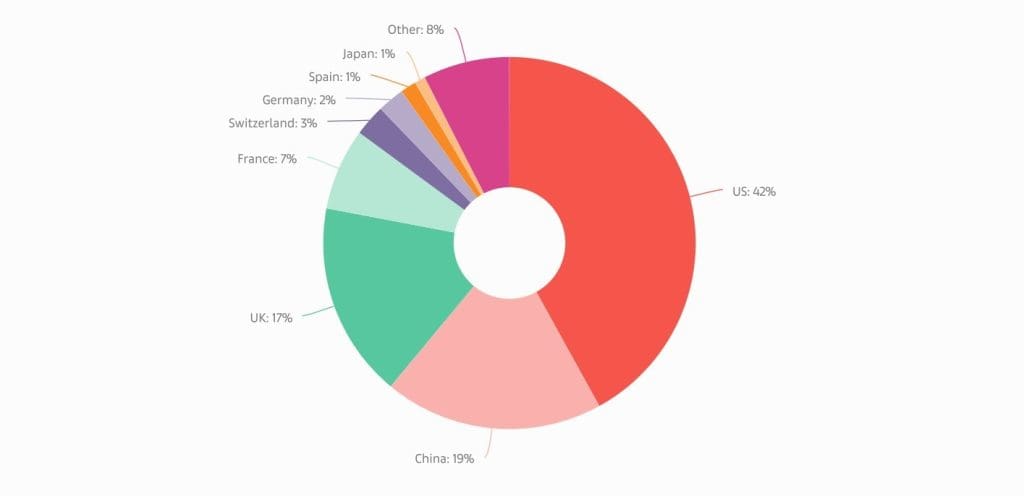
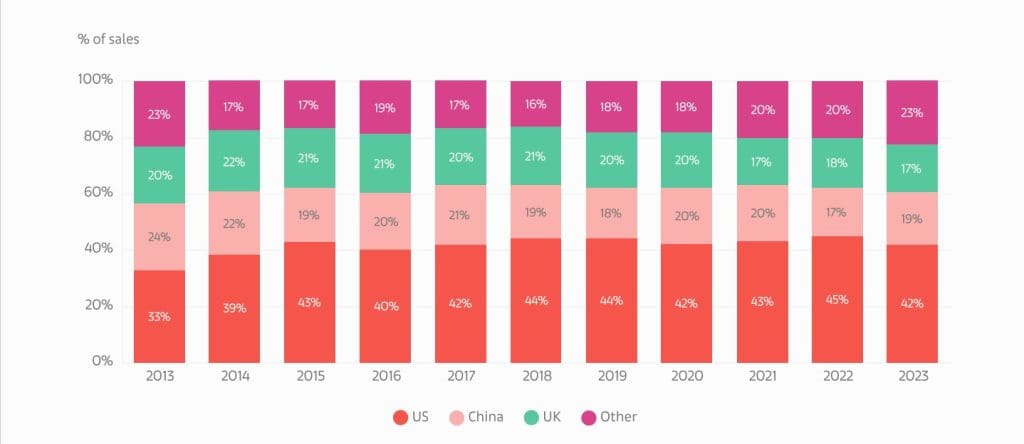
In terms of the geographic split of the art market, the top three players stayed the same. The US reconfirmed it preeminence in this regard, albeit with sales down by 25 percent from the equivalent period in 2021, 2020, and 2019. China similarly reconfirmed its place as the second largest market, but in contrast to the US, its total sales spiked by more than 110 percent during the same period. The increase illustrates the continuing strength of the Chinese collector market, but it also reflects a statistical anomaly whereby several Chinese auction houses, including Poly International and Yongle Auctions, postponed their 2022 autumn sales to early 2023 in order to comply with government lockdowns, boosting the country’s spring results.
The UK market experienced a decline in sales of 27 percent but still held third place in the global art market. The impact of Brexit and the increase in overall in logistical and importation costs still continue to effect the profitability of Britian’s historic art market.
During the pandemic and the associated lockdowns, online and digital sales increased out of necessity and market survival and drove global art sales for this period. Now that in-person auctions have fully returned, online fineart sales are hitting a plateau—but they remain far above pre-pandemic levels. A total of $155.8 million worth of fine art was sold in online-only sales at Sotheby’s, Christie’s, Phillips, Bonhams, and Artnet Auctions in the first five months of the year. That’s down 5 percent from the equivalent period in 2022 and down 64 percent from 2021, when many high-profile sales had not yet returned to being held in-person. The 2023 total remains more than 300 percent higher than 2019, when online sales generated just $35.5 million in the year’s first five months. What has changed is the comfort level of collectors to purchase via online routes – the average price in 2023 for an online purchase has dropped to $17,794 which is lower than since 2019.
In conclusion, 2023 – whilst certainly not a bullish year, it has still proved to be a strong market with no collapse foreseen in the near future. Bearing in mind the overall global uncertainties, and the fact that purchasing art is not a survival purchase, this is no mean feat!

Andy Warhol, born Andrew Warhola, was born on August 6, 1928, in Pittsburgh, Pennsylvania, to Slovakian immigrant parents. Andy was the fourth of five children, his father worked as a construction worker, and his mother was a homemaker and they lived in a working-class neighbourhood in Pittsburgh.
Andy was ‘dogged’ by illness, at the age of eight, he contracted a rare and severe illness called Sydenham’s chorea. This left him bedridden for several months, during which time his mother helped fill his days by giving him drawing lessons, which ignited his passion for art. Andy attended Schenley High School in Pittsburgh, where he demonstrated early artistic talent and where he was recognised and encouraged in these abilities. After graduating in 1945, he went on to study at the Carnegie Institute of Technology (now Carnegie Mellon University) in Pittsburgh.
After completing his studies in 1949, Andy moved to New York City, where he began his career as a commercial artist and illustrator. He worked for magazines, advertising agencies, and retail stores, quickly gaining recognition for his unique and imaginative art style.
By the late 1950s, he had started experimenting with Fine Art and had begun producing paintings, drawings, and prints. He found his inspiration in everyday objects and popular culture, leading him to create many of the works that would become iconic representations of the Pop Art movement and synonymous with Andy Warhol.
In the 1960s, he established his now famous studio space called “The Factory.” It was a hub for creative collaborations, attracting artists, musicians, writers, and celebrities, alike and it rapidly became a centre for the avant-garde in New York City.
Warhol’s fascination with celebrity culture led him to create portraits of many famous personalities, including Marilyn Monroe, Elvis Presley, and Elizabeth Taylor.
Andy Warhol’s creativity extended way beyond painting and drawing and he ventured into film, creating the experimental movies “Chelsea Girls” (1966) and “Empire” (1964), a slow-motion film of the Empire State Building.
Andy Warhol, well known for his contributions to the Pop Art movement and his choice of subjects for his art, was heavily influenced not only by celebrity and popular culture but also brand names, crime and for some reason car crashes. Some of his most famous paintings include the following:

The market for Warhol’s work has existed from day one and interest from buyers is truly international, with his work being sold across the world, where it is both a highlight and a mainstay of all the major and minor auction houses and galleries across the world. His major works continue to change hands for multi-million pound sums and the second and third most expensive Warhol works sold at auction to date are as follows:
Behind the scenes Andy Warhol is just as fascinating, here are a few little known facts about him.
Time Capsules:
Warhol was an avid collector and archivist. He had a fascination with preserving everyday items and created what he called “Time Capsules.” These Time Capsules were essentially cardboard boxes in which he stored various objects such as newspapers, correspondence, photographs, art supplies, and random items from his daily life. Over the years, he filled over 600 of these Time Capsules, which provide a unique insight into his life and the culture of the time.
Religious Devotion:
Despite his flamboyant and controversial public persona, Warhol was a devout Byzantine Catholic. He attended church regularly, and his religious beliefs played a significant role in his life. He even commissioned religious-themed artworks, including several portraits of Jesus Christ.
Art Collector:
Warhol was an enthusiastic art collector and he had his own extensive collection of art, including works by fellow contemporary artists and art pieces from various periods and styles. Following his death, Sotheby’s auction house held a nine-day auction in 1988 where they sold off more than 10,000 items from Warhol’s personal collection, which fetched tens of millions of dollars.
Underground Filmmaker:
As mentioned earlier in this piece Warhol is well-known for his contributions to the visual arts and he was also a pioneer in underground filmmaking. In the 1960s, he produced a series of experimental films that challenged traditional cinematic conventions. One of his most famous films is “Sleep” (1963), which depicts his friend John Giorno sleeping for over five hours. Warhol’s films often explored themes of monotony, voyeurism, and the passage of time.
Wig-Wearing Icon:
Andy Warhol’s signature silver-white wig became an essential part of his public image. He began wearing wigs in the 1960s to create a distinctive look, and it quickly became one of his trademarks. The wig allowed him to transform his appearance and present himself as an enigmatic figure in the art world and popular culture
Cookbook Author:
In 1959, Warhol and his friend Suzie Frankfurt co-authored a quirky and amusing cookbook titled “Wild Raspberries.” The book, which was never intended to be a practical guide to cooking, featured illustrations and handwritten recipes for dishes like “Omelet Greta Garbo” and “Piglet a la Cubist.” This limited edition book is now a highly sought-after collector’s item.
These lesser known facts highlight the diverse and eccentric aspects of Andy Warhol’s life and artistic pursuits. His impact on various forms of art and culture continues to be influential and celebrated to this day.
Throughout his life, Andy Warhol continued to push the boundaries of art, leaving a lasting impact on the art world and popular culture. His early experiences and upbringing shaped his artistic style and many of the themes he explored in his work.
Read more about investing in Warhol art here.
To get in touch about a valuation, visit our Contact Us page.

David Hockney is one of my all time favourite British artists and throughout his career he has created many truly iconic paintings. While it’s subjective to determine the “most famous” ones, here are some of his most notable works:


These are just a few examples of David Hockney’s most famous paintings, but his extensive body of work covers a wide range of materials, dates, subjects and styles, showcasing his endless versatility as an artist.
David Hockney is a renowned British artist known for his contributions to the Pop Art movement and his vibrant, colourful paintings, drawings, and prints. Hockney was born on July 9, 1937, the fourth of five children in Bradford, W est Yorkshire. He demonstrated a keen interest in art from an early age.
Hockney’s parents were Kenneth and Laura Hockney. His father, Kenneth, was a conscientious objector during World War II and worked as a conscientious objectors’ medic. Hockney’s parents were supportive of his artistic endeavours, even though they did not initially understand his decision to pursue art as a career. Throughout his life, Hockney maintained a close relationship with his family, particularly with his mother, who played a significant role in his life and artistic journey.
He attended Bradford Grammar School and then Bradford College of Art from 1953 to 1957, where he gained a solid foundation in traditional artistic techniques and disciplines. His fellow students included Derek Boshier, Pauline Boty, Norman Stevens, David Oxtoby and John Loker. Later, he pursued higher education at the Royal College of Art in London from 1959 to 1962, where he met R B Kitaj and also featured alongside Peter Blake in an exhibition there called ‘New Contemporaries’ which heralded the arrival of British Pop Art, a period when his artistic style began to take shape and evolve.
In the 1960s, Hockney rose to prominence as a key figure in the Pop Art movement, which challenged the traditions of art by incorporating popular culture and everyday objects into artworks. Alongside artists like Andy Warhol and Roy Lichtenstein, Hockney explored themes such as consumerism, mass media, and the impact of technology on society.


Here are some lesser-known facts about David Hockney: Hockney has a love of new Technology, especially that which will help him to make art, and he has embraced it in his artistic practice. He was an early adopter of the iPhone and iPad, and he has created numerous artworks using these devices. He even published a book of iPhone and iPad drawings titled “David Hockney: A Bigger Book.”
Hockney is secretly an author: In addition to his artistic endeavours, he has also authored several books. One notable example is “Secret Knowledge: Rediscovering the Lost Techniques of the Old Masters,” in which he explores the possibility that some of the Old Masters employed optical devices such as the camera obscura to aid in their artwork.
Stage design: Hockney’s creative talents extend beyond the realm of visual arts. He has designed sets for numerous operas, including productions at the Glyndebourne Festival Opera, the Metropolitan Opera, and the Los Angeles Opera. His stage designs are known for their vibrant colours and innovative use of space.
Dual nationality: Hockney holds both British and American citizenship. He moved to California in the 1960s and became inspired by the vibrant landscapes and lifestyle of Southern California, which greatly influenced his artwork during that period.
Knighthood: In 1990, David Hockney was awarded the Order of the British Empire (OBE) for his contributions to the arts. Later in 2012, he was further honoured with a knighthood, becoming Sir David Hockney.
Love for nature: Hockney is drawn to the beauty of nature and has spent considerable time painting landscapes, particularly in his native Yorkshire. He finds inspiration in the changing seasons and has captured the essence of nature’s colours and textures in his artwork.
David Hockney has had several close friends and acquaintances throughout his life, including notable figures from the art world, literature, and entertainment industry. Some of his close friends include, Peter Schlesinger, an artist and photographer, was one of Hockney’s closest friends and a frequent subject of his paintings. They were in a relationship during the late 1960s and early 1970s.
Celia Birtwell, a renowned textile designer and fashion icon, became friends with Hockney in the 1960s, and he often used her as a muse in his paintings. Birtwell’s vibrant and patterned fabrics also influenced Hockney’s artistic style. Ossie Clark was a British fashion designer and a close friend of Hockney. Clark’s designs were known for their bohemian style, and Hockney often collaborated with him, creating artwork inspired by Clark’s fashion. Jonathan Silver was a major patron and collector of Hockney’s work. He was a close friend of the artist and played a significant role in supporting and promoting his career at his gallery space at Salt’s Mill in Bradford.
At 86 David Hockney is a shining example of how making art and being constantly busy and creative can stop the years creeping up on you, long may he continue!
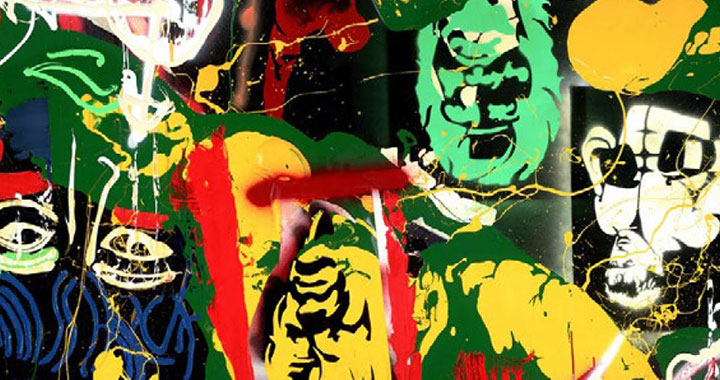
‘Never judge a book by its cover’ – that’s what we’re always told. We never know what’s really happening beneath someone’s public persona – and none more so than with famous actors or musicians, who we think we know so well through their film or music. But this fame and celebrity can often be misleading as many of the most famous celebrities have kept a secret from their fans – the secret being that they are artists (painters, photographers, sculptors) independent of their day jobs. In fact, in some case, the celebrities identify more as visual artists than their more famous personas!
Below are 10 celebrities who might surprise you with their double life!
David Bowie was undoubtedly one of the greatest creative forces of the 20th century, known for his ability to effortlessly reinvent himself over and over. It’s not surprising, therefore, that his creativity was also multifaceted and that he was a practicing visual artist for as long as he was a musician. Until 1994, however this side of his work remained unknown to the public. For the glam icon, painting was an essential part of the musical process.

As he explained during a conversation with The New York Times in 1998: ‘I’ll combine sounds that are kind of unusual, and then I’m not quite sure where the text should fall in the music,’ he explained, ‘Or I’m not sure what the sound conjures up for me. So then I’ll go and try and draw or paint the sound of the music. And often, a landscape will produce itself.’
Bowie was also a devoted art collector, and he had a close affinity with the work of Jean-Michel Basquiat.

‘I feel the very moment of his brush or crayon touching the canvas, there is a burning immediacy to his ever-evaporating decisions that fires the imagination ten or fifteen years on, as freshly molten as the day they were poured onto the canvas. It comes as no surprise to learn that he had a not-so-hidden ambition to be a rock musician. His work relates to rock in ways that very few other visual artists get near.’
Jim Carrey’s comedy and movie background is already legendary, but most people don’t realise that he is also an artist with a number of public exhibitions under his belt! Carrey has been drawing and painting since childhood, and not surprisingly considering his sharp wit and edgy sense of humour, his art is highly political and satirical; criticising and digging into the woes of modern-day America. Carrey is both a painter, sculptor and print maker.


In common with many of his actor / artist contemporaries, Carrey uses his art to ground and settle him, to enable him to switch off. As he says, ‘When I sculpt and paint is when I feel the most present and in harmony with the environment; as if all time has been suspended, all gravity disappears.’

As if he wasn’t content with being one of the most iconic musicians of modern times, Bob Dylan has also established himself as a painter and sculptor of international acclaim. The ‘Blowin In The Wind’ singer has been given pretty much every award you can think of, including the Pulitzer Prize, The Presidential Medal of Freedom, the Nobel Prize for Literature, an Oscar, and the National Medal of Arts.

Dylan dates the beginning of his work as a visual artist to the early 1960s. A few drawings reached the public gaze with album covers like Music from Big Pink (1968) and Self Portrait (1970), but it was not until 1974, that Dylan started to take his art serious. He spent two months studying art with Ashcan School tutor Norman Raeben, who philosophised the importance of ‘perceptual honesty’ – painting life as it as seen, not imagined. Dylan says of this time: ‘He put my mind and my hand and my eye together, in a way that allowed me to do consciously what I unconsciously felt.’

The inspiration behind Dylan’s art are travels – the cities and towns he visits appear on the canvases he produces, interpreted in the brightly graphic, expressionistic style he has made his own. He says his art is about the instant moment of a place, person and time, and it has found enormous appeal with audiences worldwide. The combination of the Dylan name and his accessible imagery is a winning combination.

Dylan’s first major retrospective, Retrospectum, opened in the Modern Art Museum Shanghai in 2019/20 and was visited by over 100,000 people in the first three months. He is now represented by a number of heavy hitting international galleries such as Halcyon and Opera Galleries.
From Hell’s Angels and hippies to the streets of Harlem, Dennis Hopper’s photography powerfully captures American culture and life in the 1960s, a decade of progress, violence and enormous upheaval.

Hopper carved out a place in Hollywood history, with roles in classic films like Apocalypse Now, Blue Velvet, True Romance and Easy Rider. He is less well known, though no less respected, for his work as a photographer.
In 2014 Hopper’s photographic work was the subject of a major retrospective exhibition at the Royal Academy in London – entitled: Dennis Hopper – The Lost Album. This exhibition brought together over 400 images, taken during one of the most creative periods of his life in the 1960s.

This was a decade of huge social and political change, and Hopper was at the eye of the storm. With his camera trained on the world around him he captured Hell’s Angels and hippies, the street life of Harlem, the Civil Rights movement and the urban landscapes of East and West coast America. He also shot some of the biggest stars of the time from the worlds of art, fashion and music, from Andy Warhol to Paul Newman.

Together, these images are a fascinating personal diary of one of the great countercultural figures of the period and a vivid portrait of 1960s America.
More commonly known for her roles in the movies Kill Bill and Charlie’s Angels, as well as the TV show Elementary, the American actress Lucy Liu is also a very talented abstract artist. She has painted for years, under the pseudonym Yu Ling.

Liu’s interest in art began at the age of fifteen, when she started experimenting with collage and photography at Stuyvesant High School in New York City. She graduated from the University of Michigan in 1990 with a B.A. degree in Asian Languages and Culture, before moving to Los Angeles to pursue her interest in acting. Her first solo exhibition, Unraveling, at Cast Iron Gallery in New York in 1993, was a photographic exhibition that earned her a grant to study at Beijing Normal University. Liu found this period in China to be extremely valuable, not only as an opportunity to learn more about her Chinese heritage, but also to expand her understanding of the symbolic potential of art. The trip became the subject of a body of work shown at her next one-person exhibition, Catapult, at Los Angeles’ Purple Gallery in 1997. Liu remained in Los Angeles for several years, during which time she continued to work in collage and photographic portraiture. She returned to New York City in 2004 and enrolled in painting classes at the New York Studio School from 2004-2007.

Ongoing conceptual concerns in Liu’s artwork have been the notions of security, salvation, and the long-term effects of personal relationships on our physical and emotional selves–themes that she addresses in painting, sculpture, collage, silkscreen, or the appropriation of discarded objects, which Liu recontextualizes in handmade constructions that function as reliquaries.

Her work has been featured in numerous gallery exhibitions and international art fairs, and is included in multiple private and corporate collections. Liu currently lives and works in New York City.
The Beatles were a true global phenomenon within contemporary culture – arguably the world’s most famous band, against who all other bands are measured. In addition to this, Paul McCartney is one of the most successful composers and performers of all time. He has written or co-written 32 songs that have reached No. 1 on the Billboard Hot 100, and as of 2009, had sales of 25.5 million RIAAcertified units in the United States.

For more than thirty years, alongside his music career, McCartney has been a committed painter, finding in his work both a respite from the world and another outlet for his drive to create. His paintings were a very private endeavour until 1999 when he decided to share his artwork with a public exhibition and a book titled ‘Paul McCartney Paintings.’ His work is now represented by a number of galleries internationally.

McCartney’s works are full of intense colour and life – his paintings reveal McCartney’s tremendously positive spirit as well as a visual sophistication. The combination of techniques, such as scratching, wiping and applying paint directly from the tube, clearly documents on the one hand the artistic process as it takes place on the canvas but creates on the other hand the illusion of objective realism, with the elements air, water and earth. Faces abound in his paintings and humour plays against a more sombre imagery, while his landscapes radiate a sense of place.

Think of Joni Mitchell and think primarily of her incredible career as a singer, songwriter and musical innovator, whose songs have helped define an era and generation. She has received many accolades, including nine Grammy Awards, and has released 19 studio albums. Much less has been written of her life as a painter. It might surprise fans to hear that Joni has always considered herself to be a painter first and a musician second!

Joni started painted extensively in the ’60s and has never stopped since, except for a few brief, ill-advised forays into photography in the 1980s. The ’60s paintings are almost exclusively portraits of those around her, often drawn from reproductions of sketchpad drawings made on the road or in recording studios. Those around her are mostly men: some of them lovers (Graham Nash, David Crosby), some friends and professional barometers (Neil Young, Bob Dylan), but for their cheery, empty impersonality, they might as well be strangers.


Stevie Nicks, the evocative lead singer of the folk rock band Fleetwood Mac, has painted throughout her long career, but yet she says she doesn’t really think of herself as a painter. This modesty belies a body of work which almost perfectly reflects the essence of her music, and evokes the bucolic feel of the Pre-Raphaelite Brotherhood. Her paintings are at once folkish and deeply biblical.

‘They’re all angels,’ she said of her art. ‘I only draw angels. I started to draw when my best friend got Leukemia. And that’s what she’s left me. And so I know she’s really excited now because it has finally, after the last 9 years, come to fruition, and people have finally started appreciating it. But I never drew a thing before she got sick.’

Sylvester Stallone has been an icon in the film world for decades, best known for writing and starring in the blockbuster movie franchise Rocky. But few of his fans realise that he has been painting for almost as long as he has acted – nearly 50 years.

Stallone’s work has evolved over the decades, with later canvases veering towards abstract forms and a reduced colour palette of black, white, and red. Stallone cites the works of Jean-Michel Basquiat, Francis Bacon, and Kasimir Malevich as his key influences, as well as Andy Warhol, for whom he famously posed in a series of photographic portraits in the 1980s. A prolific screenwriter, he often used art to help conceptualize his characters; including his 1970s painting Finding Rocky served as a means of entry into his character’s mindset. Stallone’s works have been featured in retrospective museum exhibitions in St. Petersburg, Russia, and Nice, France.

Who would have thought it, but this quintessential bad boy of rock ‘n roll has consistently found solace in art and has painted throughout his wild days in the Rolling Stones. Ronnie Wood says: ‘There is no kind of therapy like the one you have from starting a picture and then seeing it through to the end.’

Having received formal art training at Ealing College of Art, Ronnie has been a prolific painter since his teens. He has described painting as being like therapy and would create portraits of figures he admired. Elvis Presley, Jimi Hendrix and fellow band member Mick Jagger are just a few of those he has painted, along with other musicians, friends and family.

Varying his medium depending on the mood he wishes to evoke, Ronnie creates his original pieces in charcoals, oils, watercolours, spray paints, oil pastels and acrylics. His subjects range from band members and musicians he admires to close friends and self-portraits.

For Ronnie, music and art have always gone hand-in-hand, and the intensity that he brings to the guitar translates onto canvas and paper with rhythmic line and vibrant colour. Ronnie’s paintings are a record of his many talents and loves. One of the things he most enjoys is to paint the views from his farm in County Kildare Ireland and the horses he keeps in stables there, allowing him time to take time out from both the media attention that follows him everywhere and also work on his future projects, both with the Rolling Stones and other musicians, in a more secluded atmosphere.
‘I apply musical theory to my art. I build artworks in much the same way as studio overdubs, the more defined ones are things that stand out in the mix.’

Lowry’s painting, ‘Going to the Match’ from 1953 depicts a bustling throng of football fans gathered at the former home of Bolton Wanderers. It won Lowry first prize in a 1953 exhibition, which was sponsored by The Football Association.
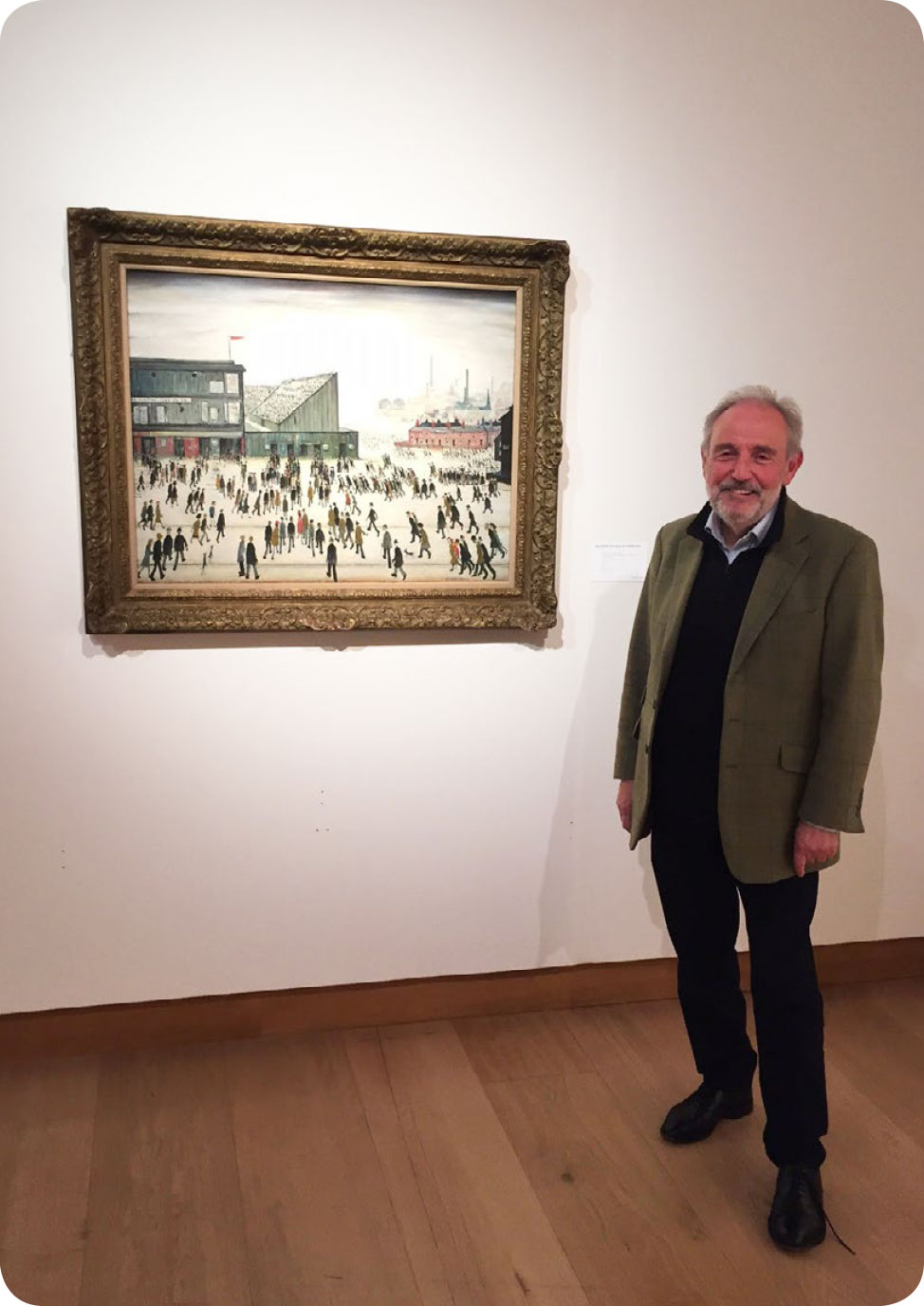
Jonathan Horwich with L.S Lowry’s ‘Going to the match’.
The painting, last came up for auction in December 1999, just days away from the new millennium and the dawn of the new technology that has changed all our lives and turbo charged the Art and Auction world.
The estimate back then was £700-900,000 which was itself a world record estimate and the final price of £1.9 million was also a new record which stood for almost 10 years! ‘Going to the Match’ was bought by Graham Taylor, bidding via phone, on behalf of the Professional Footballers Association, (PFA) the footballer’s Trade Union.
From the auction it went on long term loan to the Lowry in Salford, where until April this year it was on permanent display to the public.
Last night in London, 22 years on, it was back on the auction block, again with a world record estimate of £5-8 million and after a fierce auction battle it deservedly made a new world auction record price of £7.8, far exceeding the previous record for a Lowry of £5.6 million set in 2011.
The PFA recently transferred ownership of the picture to their charitable arm, the Players Foundation so that now all the sale proceeds
will go towards helping those in need. Even better, thanks to the generosity of the Law Family charitable trust run by Andrew and Zoe Law, the Lowry Gallery in Salford were able to bid successfully at the auction and so now they will soon have their visitor’s favourite Lowry picture back again on the wall in Salford Quays so we can all enjoy it now and into the future.
Throughout history the Crown has used portraiture to define and promote its official image – the image which each successive monarch chooses to portray itself to the Nation. These images, whether they show the monarch as a great head of State, or as a triumphant military leader or even as the embodiment of middle-class values, have eventually come to define the visual culture of each passing generation.
With 70 years on the Throne, Queen Elizabeth II is the United Kingdom’s longest-reigning monarch, surpassing even her great-great-grandmother, Queen Victoria, who reigned for 63 years. Throughout her long reign Queen Elizabeth II has overseen the greatest political and social changes this county has ever seen. She was born into a country which still sat at the centre of a global empire, and during her reign she oversaw the evolution of the Commonwealth of Nations.
The United Kingdom has emerged from a post Edwardian society to a vibrant, modern, multi-culture one. All this in one lifetime.
From Cecil Beaton to Pietro Annigoni, from Andy Warhol to Lucian Freud, and more recently Jamie Reid to Chris Levine – Britain’s longest reigning monarch has been painted by some of the greatest artists of her time, with each image recording the ever-evolving relationship between the Queen and her people. But what is unique about the Queen’s portraits in the history of royal portraiture, is that her face has been appropriated to become an icon of popular culture. She is both a Queen, a Pop icon and a defining symbol of punk subversiveness!
Over her long life and reign, Queen Elizabeth II became the most photographed and depicted person in Human history, and her image has become embedded in the world’s cultural consciousness. Never in the history of Human history has one person been portrayed so.
Cecil Beaton
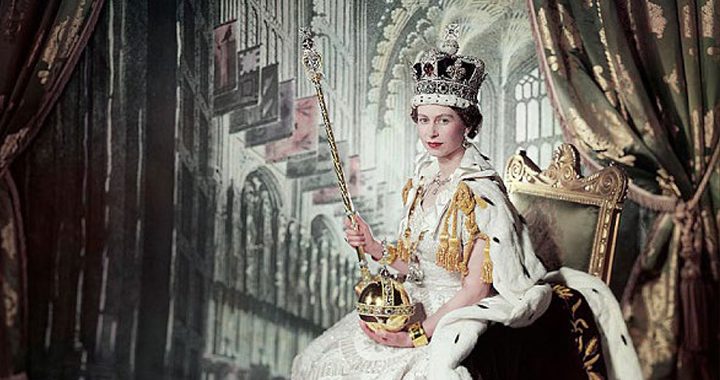
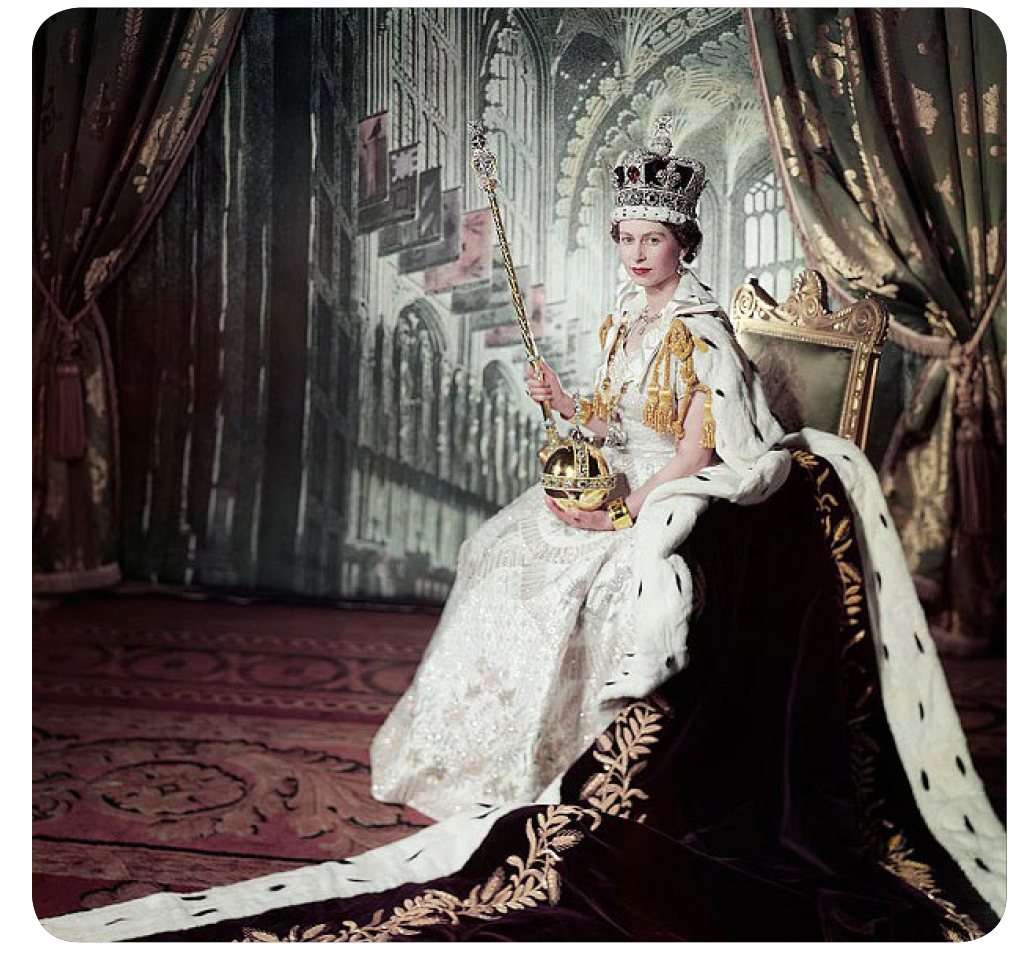
The fashion designer, Cecil Beaton, was unusually chosen to take the official coronation portrait of Queen Elizabeth on June 2, 1954. The image he created came to define the first decade of the Queen’s reign and symbolised the new Elizabethan age she heralded in. At its heart, the image is fundamentally rooted in the tradition of Royal portraiture, with the Queen shown in all the majesty of her Coronation robes – with the Imperial State Crown on her head and the orb and sceptre in her hands. Beaton manages to capture the Queen as both intensely royal but also yet somewhat vulnerable due to her youth.
Interestingly, whilst this is an intensely traditional image, the medium of photography with which it was created, together with Beaton’s visual trickery also makes it a surprisingly modern one. Although the image appears at first glance to be set in Westminster Abbey, the photographer actually employed a theatrical backdrop for the photo, which was taken in a drawing room at Buckingham Palace.
Pietro Annigoni
In 1954, two years after her coronation, the Italian artist Pietro Annigoni painted the first of his two famous portraits of the Queen. Commissioned by the Worshipful Company of Fishmongers in London, the painting is universally considered the most beautiful ever painted of her and is the queen’s known favourite. The artist shows the beautiful young queen in the magnificent robes of the ancient Order of the Garter and set within a beautiful Italianate landscape worthy of any Renaissance master. The resulting image is a supremely elegant and glamorous one, which has appeared on stamps and currency in British dependencies across the world.
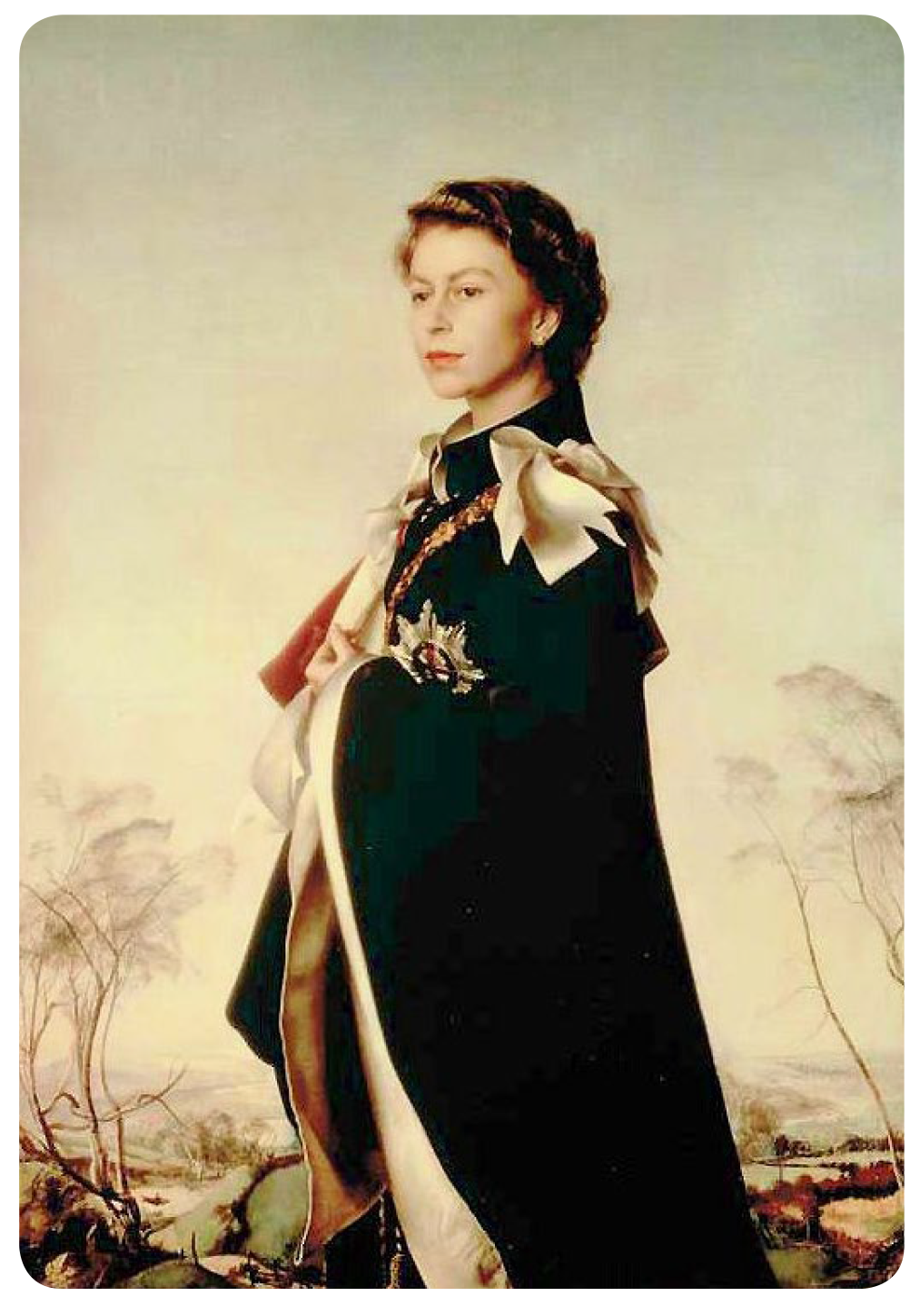
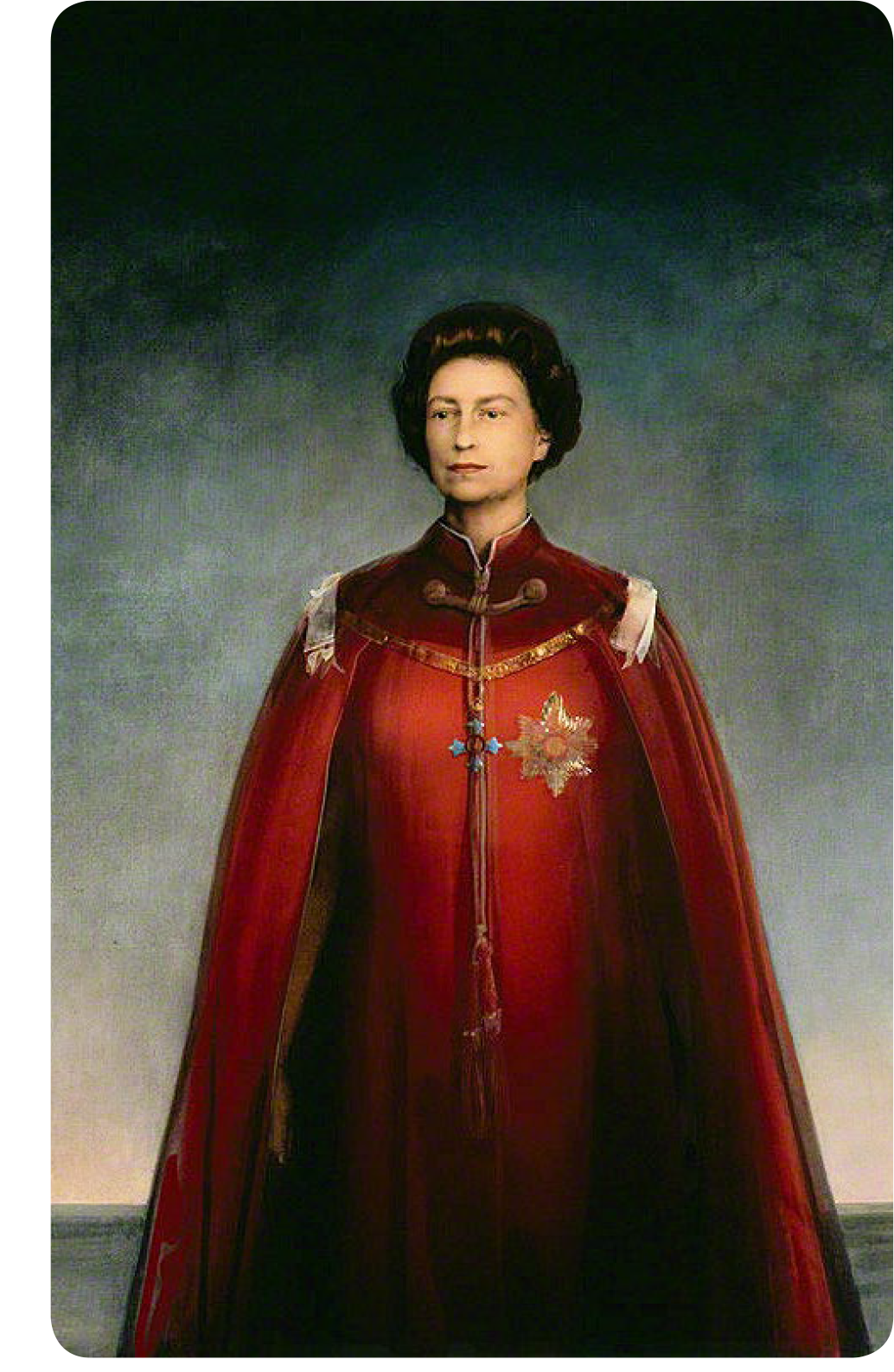
In 1969, at the request of the Queen, the National Portrait Gallery in London, commissioned Annigoni to paint her portrait again. This time, however, the artists decided not to paint her as a glamorous young monarch, but rather as a much more remote Regal figure, silhouette starkly against an almost abstracted background. As the artist said himself, “I did not want to paint her as a film star, I saw her as a monarch, alone in the problems of her responsibility,” said the artist of the striking difference.
Jamie Reid
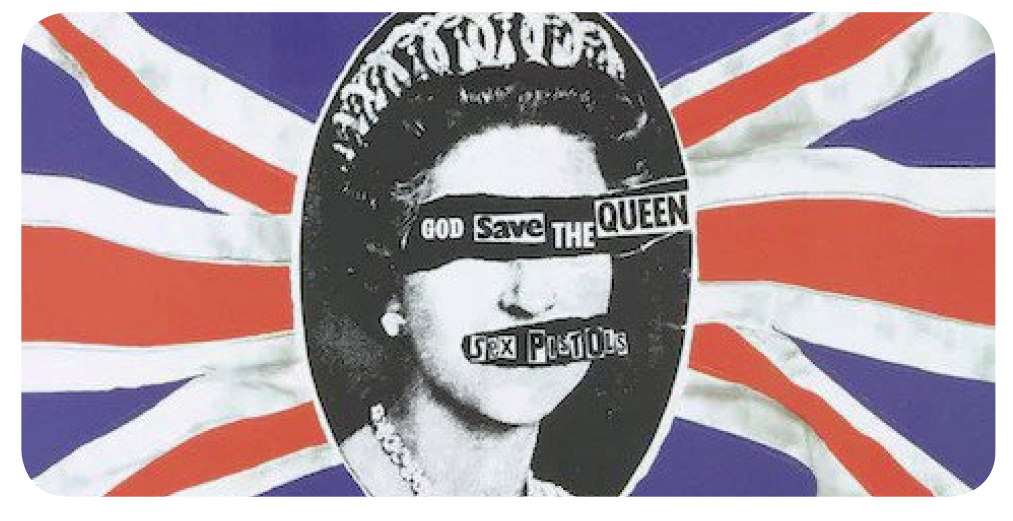
The 1970s saw Punk Rock explode onto the British scene. Anti-establishment and anarchic, Punk challenged everything the previous generation held dear, and its influence was truly global. How ironic then, that one of Punk’s greatest images is Jamie Reid’s famous Sex Pistol’s album cover showing the Queen superimposed across the Union Jack! The figure head of the Establishment being used to subvert itself. To this day, it is one of the most influential images of the Queen of all time.
Andy Warhol
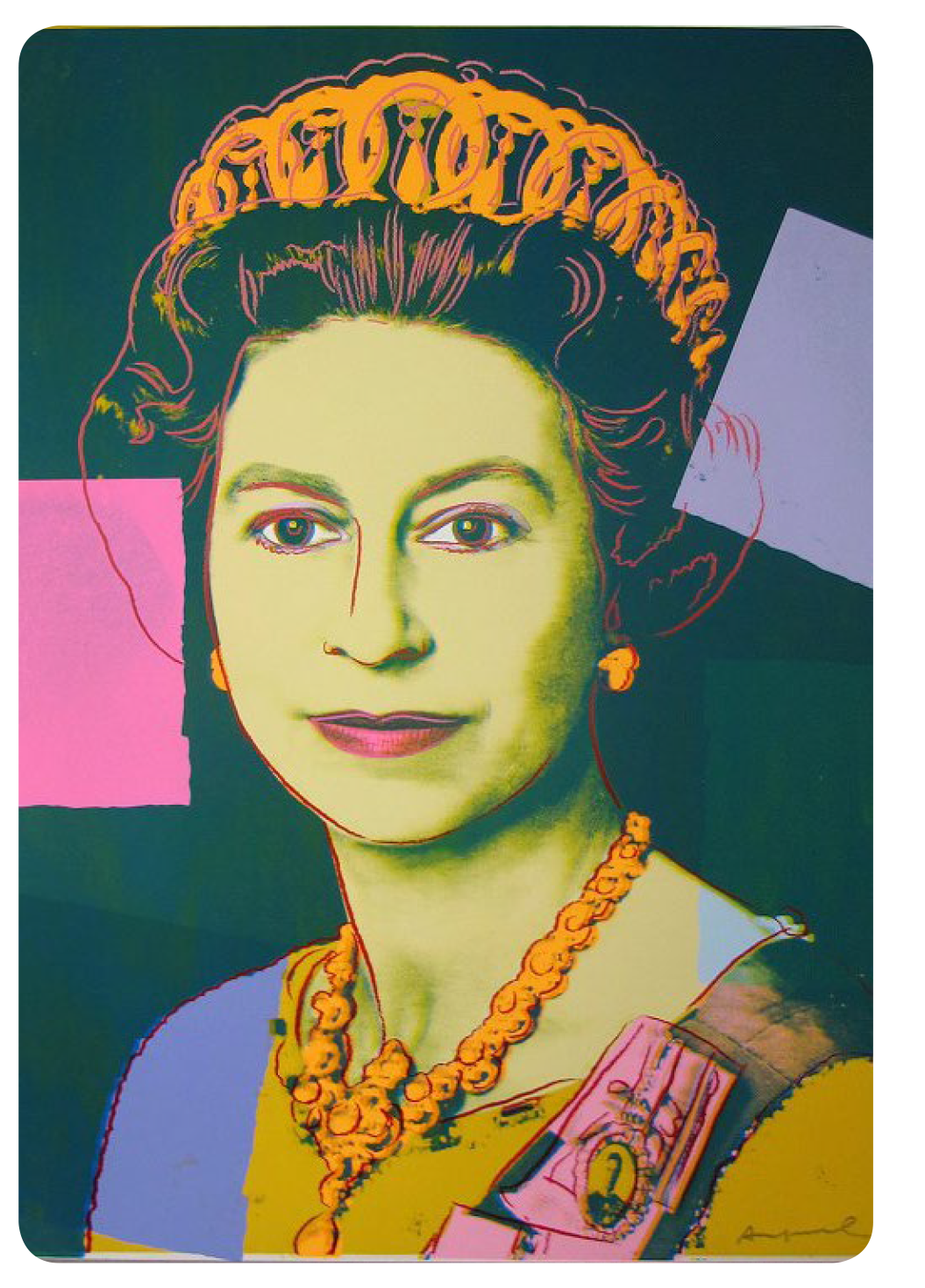
In 1985, the king of Pop Art Andy Warhol, produced his Reigning Queen’s portfolio of prints – a set of 16 portraits of the world’s four reigning Queens – Queen Margrethe II of Denmark, Queen Beatrix of The Netherlands, Queen Ntombi Twala of Swaziland and of course, our Queen Elizabeth II of the United Kingdom. Warhol chose to depict these female monarchs, as powerful matriarchs – queens who ruled in their own right and were not queens through marriage. These portraits represent independent female authority, a different view on femininity in comparison to Warhol’s portraits of the likes of Marilyn Monroe and Billy Boy.
Lucien Freud
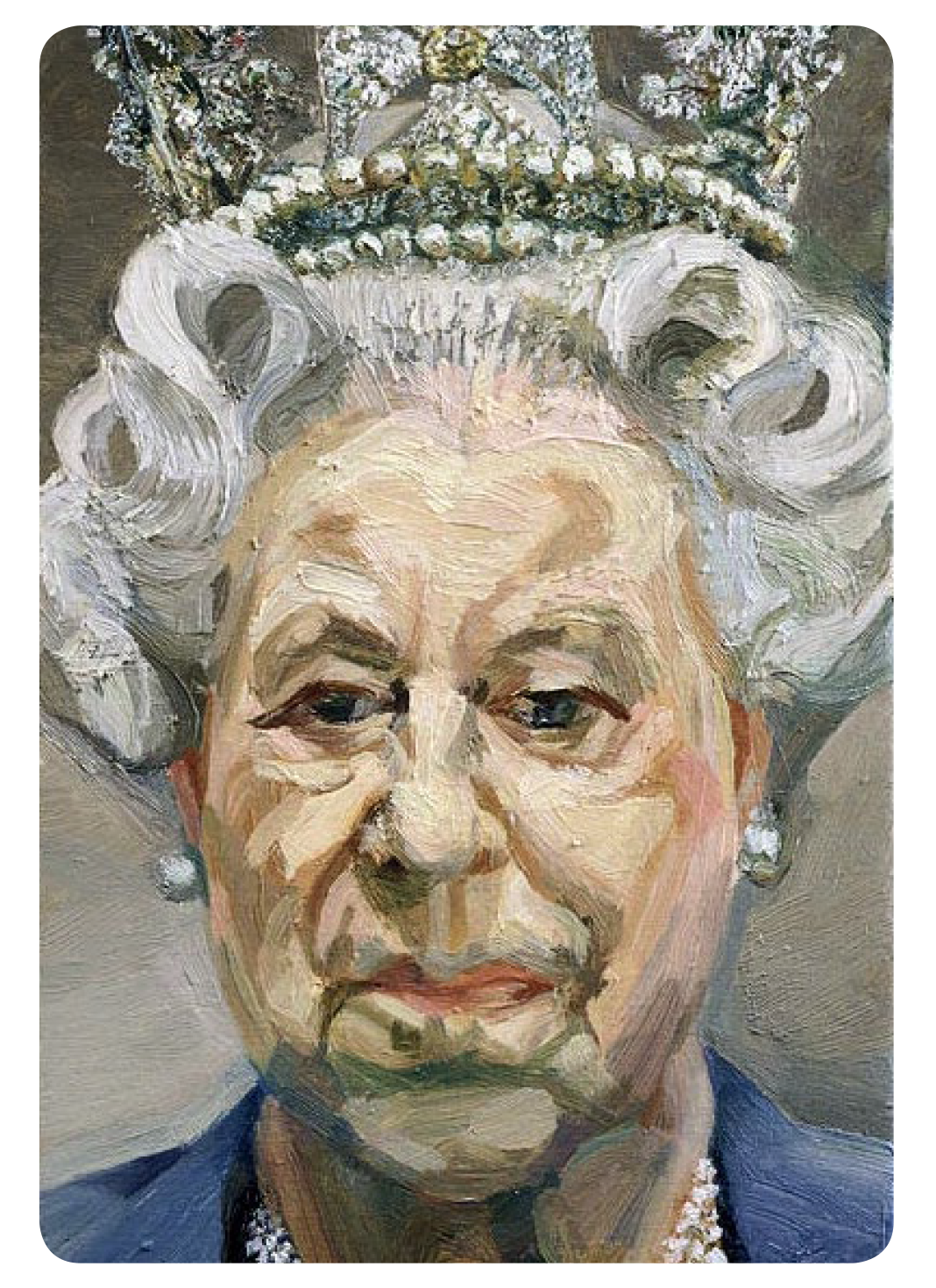
In 2001 one of Britain’s greatest living painters, Lucien Freud, painted his tiny but highly controversial portraits of the Queen. Originally meant to depict the Queen informally without a crown or tiara, Freud had to subsequently expand the canvas by 3.5cm when he decided to include the 1820 Diamond Diadem! Without doubt the most controversial of all the Queen’s portraits, this tiny work has divided audiences since it was first exhibited. Whilst certainly not one of her Majesty’s most flattering portraits, the way that Freud has disregarded the entire tradition of Royal portraits is certainly unique.
Alison Jackson
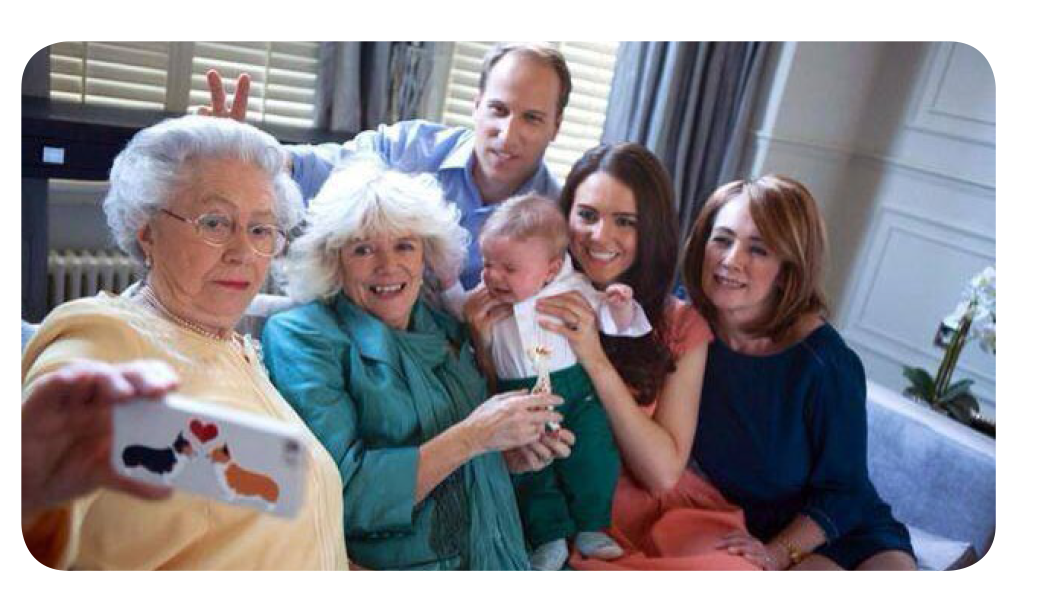
Whatever next – the Queen taking selfies?! Well not quite! This faux royal family selfie is the work of Alison Jackson, a British photographer who has made her reputation creating convincing personal photos of intimate moments experienced by British celebrities using look alike actors. Alison Jackson’s genius lies in her ability to cast convincing doppelganger actors in the role of her famous sitters in entirely convincing, yet fake situations. One can only guess that Her Majesty must get a kick out of such fun…..the Queen as a social media savvy influencer monarch!
Chris Levine
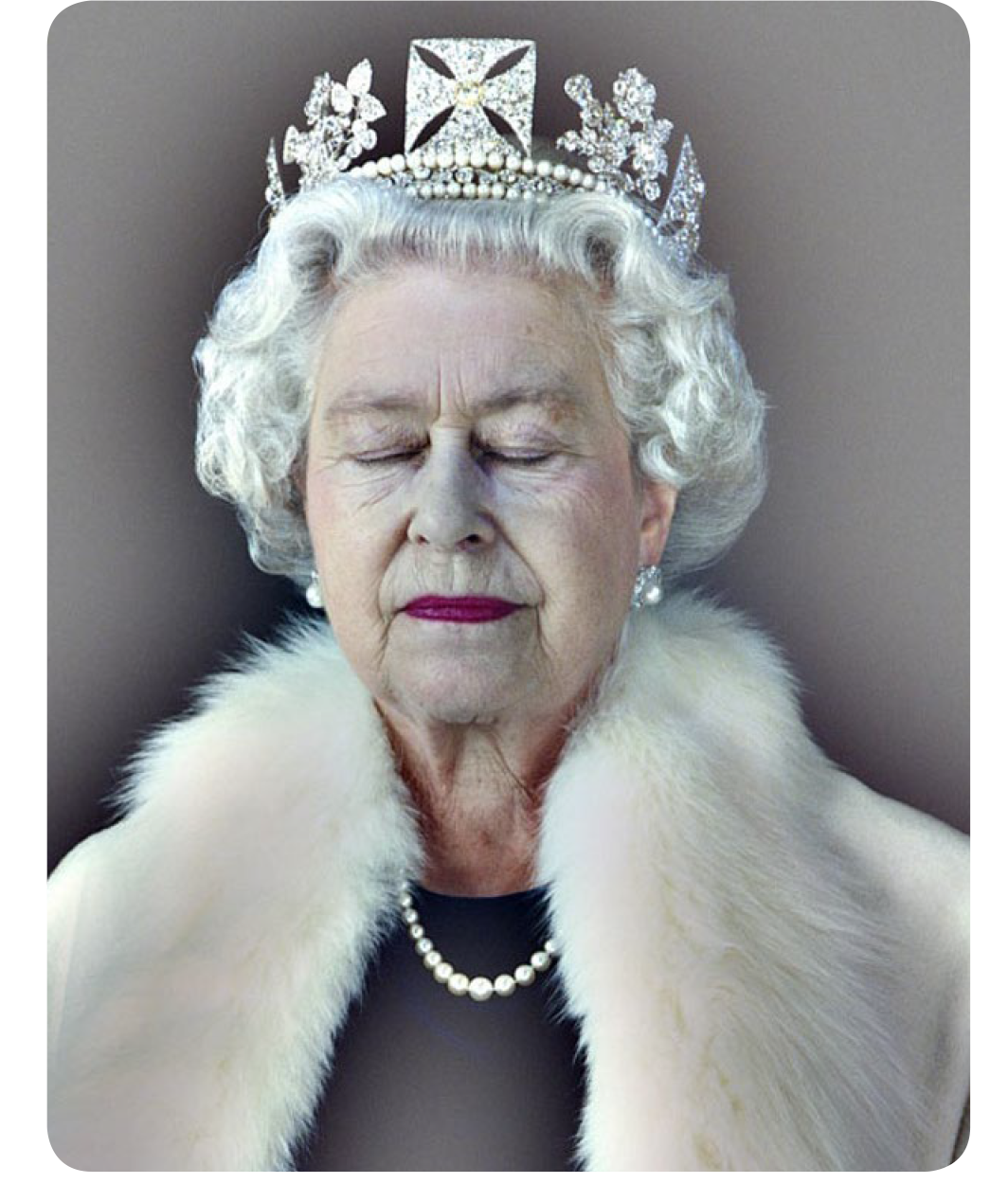
In 2004, British artist Chris Levine created what can only be described as a modern classic when he produced his, Lightness of Being portrait of the Queen. The work which he produced in various formats, shows the Queen beautifully dressed in white fur and pearls, wearing the 1820 Diamond Diadem. However, what is disarming about the image is that the Queen is depicted with her eyes closed in contemplation. The artist explained how the image came about, “I wanted the Queen to feel peaceful, so I asked her to rest between shots; this was a moment of stillness that just happened.” The resulting image is indeed peaceful and calm, yet it is also full of gravity and power – a monarch who has reigned over us for 70 years.