One might describe Fabergé’s eggs as small and perfectly formed, and the same could be said for its current London exhibition – The Art of Wonder.
Set up as part of the Maison’s global celebration of Peter Carl Fabergé’s 180th anniversary, it’s a little peek behind the curtain of some of his magnificent work. These sit alongside contemporary pieces, proving that his inspirational resonance endures, undiminished by the passage of nearly two centuries.
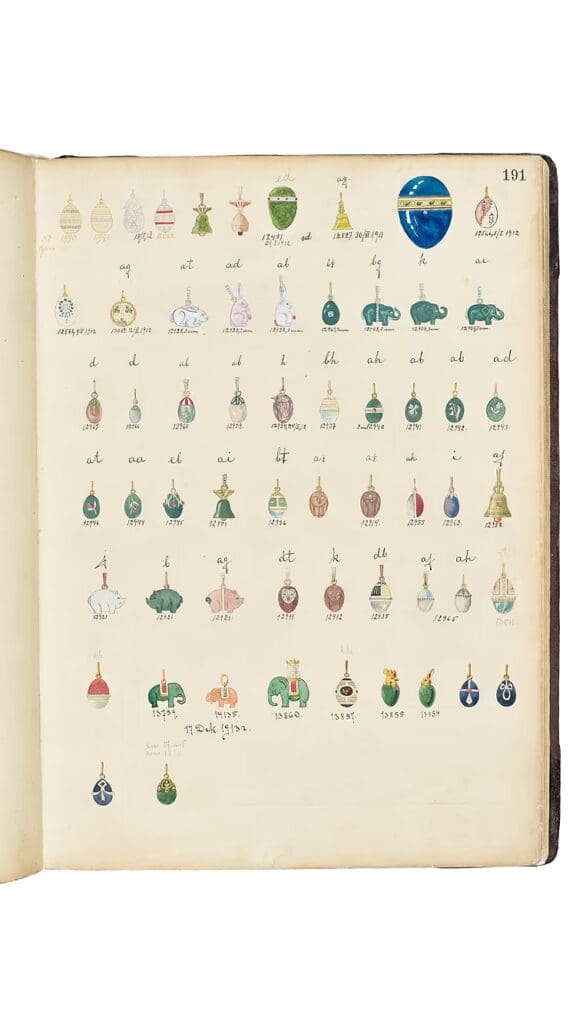
It must have been an incredibly exciting day for their design team last December when the company obtained one of only three remaining Fabergé design albums known to have survived – the other two are in the National Archives of Finland and in the State Hermitage Museum in St. Petersburg, Russia. This one is from the workshop of Henrik Wigström, the celebrated Fabergé master of St Petersburg. With more than a thousand incredibly detailed drawings made between 1911 to 1916, it showcases a wide variety of life’s essentials, from parasol handles, to bonbonnières, letter openers, and everything in between. What a total joy it would be to sift through its pages! With a hammer price at Christie’s of £508,000 it is not surprisingly firmly locked away, but left tantalizingly open to page 191 of exquisitely hand painted pendants.
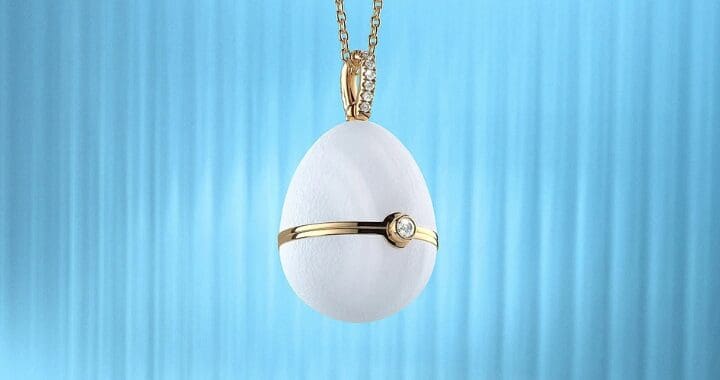
Inspired by a design from this very page, a new limited edition pink opal egg pendant was made exclusively to accompany the exhibition and is only available in their London store.
Rarity sits high on the list of making jewellery desirable. In the late 19th to early 20th centuries in Russian high society, individuality was key. To avoid the immense social embarrassment of duplicate jewellery, wealthy aristocrats commissioned custom pieces from elite jewellery houses such as Fabergé, Bolin, and Khlebnikov.
Currently on show is a necklace displaying 14 original unique Imperial egg pendants, along with a coral hand pendant which, while not totally on theme, is a beautiful example of their artistry. Displaying an intricate array of colours, patterns and sizes, it’s a fantastic example of their bespoke approach.
These are sadly not for sale, however, if an Imperial pendant is on your wish list, Bentley & Skinner currently has a white and red enamelled easter egg pendant with a relief of Empress Elizabeth available, made in circa 1895-1898, and retailing at £24,750.
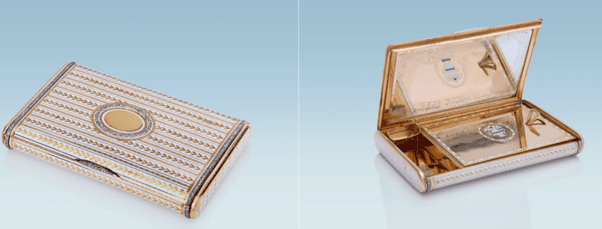
Of course, Fabergé didn’t just make jewellery. This minaudière in champléve enamel and set with diamonds contains two compartments and a mirror; perfect to accompany an elegant Grand Duchess on an early 20th century evening soiree, but slightly less useful for those of us needing a bit more space for our phones. More fool us.
A similar Fabergé minaudière can be found on Heritage Auctions with an asking price of over $75,000.
An estimated 150,000 to 200,000 objects were created by Fabergé during the firm’s existence, and it is thought that bell pushes represented around 2% of that number. In the aristocratic world of staffed houses, mechanical bell pushes were essential. With the invention of electricity, Fabergé embraced this new technology and its bell pushes were mostly electric.
This guilloché enamel bell-push, of gem-set silver and rhodonite, was made by workmaster Anders Nevalainen in St Petersburg around 1899-1903. A similar bell push sold at John Moran auctioneers in 2024 for $24,130.
Driven by a desire to repatriate original masterworks, Fabergé’s current owners are actively acquiring archival treasures, meaning some incredible historic objects could soon resurface. Watch this space to see how the master craftsmanship of these finds translates to their new collections.
The story of Fabergé is a reminder that beauty and value are often found in the objects we live with everyday and that their significance can be easy to overlook. From jewellery and watches to works of art, antiquities, rare books and other cherished collectibles, their value may have changed significantly over time. We offer discreet, expert valuations, helping clients establish the true value of the objects that matter to them and ensure they are appropriately insured for the future.