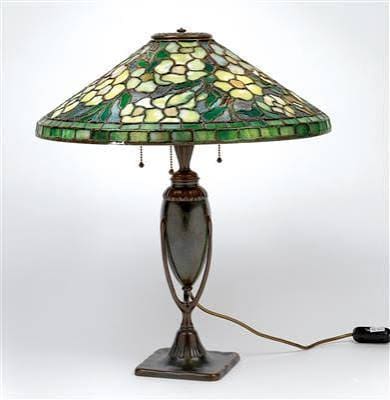
There is a small amount of magic when viewing Tiffany glass. Switch off the lamp and it can look brooding, almost muddy; switch it on and a garden appears. That trick of changing character with the light is one reason genuine Tiffany remains so desirable. It also explains why the words “Tiffany-style” have been worked quite so hard by everyone else, and mostly by auction houses.
Louis Comfort Tiffany was the son of Charles Lewis Tiffany, founder of Tiffany & Co. – the one that we all know, write about, and lust after – but the glass was very much the son’s affair. In late 1892, Tiffany had established a glasshouse at Corona in Queens working with the English glassmaker Arthur Nash, he developed glass in which colour and texture were part of the molten material, rather than decoration applied afterwards. He called it Favrile, drawing on an old word for hand wrought – this would go on to change the style and impact of early American glass for good.
It is tempting to picture Tiffany alone, sleeves rolled up, making everything himself. However, he was the artistic director of a large studio employing designers, selectors, cutters, glassmakers and metalworkers, much like many modern artists of today. Clara Driscoll, who ran the Women’s Glass Cutting Department (yep, remember this was the 19th century), actually designed some of the most celebrated shades. Her ‘Tiffany Girls’ selected glass for some of the most celebrated pieces that we see, the name on the lamp may be Tiffany, but the hand behind it was often female.

The lamps are the obvious stars – Dragonfly, Wisteria, Poppy, Daffodil, Peony and Dogwood. They are not simply stained-glass shades placed upon bronze bases. The best examples use rippled, mottled and confetti glass to model petals, leaves and insect wings without painting them. Look at a Daffodil shade and the trumpet of the flower can be shown through a marvel of texture alone. In a Dragonfly, the lead lines become the insect’s anatomy, and not just a means of holding the glass together.
Auction figures give some incredibly interesting results – in September 2025, an early Poppy table lamp realised approximately £213,000 including buyer’s premium in the United States, whilst two Dogwood lamps sold during 2025 for markedly different sums: approximately £111,000 including premium in May and £75,700 including premium in December. Those are different objects, of course, and the gap is a useful warning against valuing by pattern name alone and why inspection and correct valuation are key.
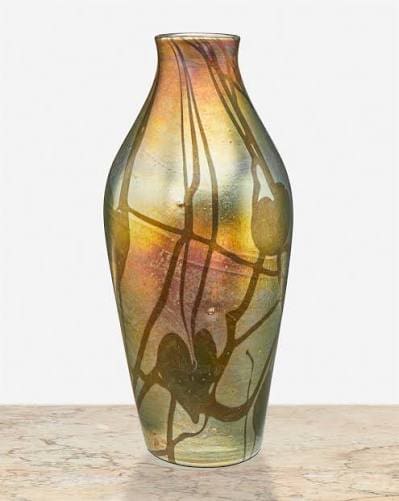
At the more approachable end, a circa 1900 Favrile vase, 13½ inches high, realised approximately £11,400 including premium in the United States in April 2025; another early vase in the same American sale made approximately £19,000. In February 2026, a much smaller gold Favrile three-handled vase sold online for approximately £850 including premium. Whilst the majority of the big sellers will always be in the United States, there are always a good selection of items that have crossed the pond.
For insurance, auction results are evidence of market demand, and we need to look at what it would reasonably cost to replace the object through an appropriate specialist. Whilst supply and demand can see prices fluctuating just as much as auction prices, I can find examples currently of dealers asking for £221,000 for a circa 1910 Poppy lamp, £92,300 for a circa 1905 Daffodil, £102,700 for a millefiori lantern formerly at Tiffany’s own Comfort Lodge, and £65,600 for a circa-1893 Good Neighbour window.

A good valuation and inventory must therefore record exactly what is owned: dimensions, marks, shade and base numbers, condition, repairs and provenance. A married shade and base, however attractive, is not the same proposition as a lamp that has remained together. Cracks, replacement glass and an over-cleaned bronze patina also matter. It’s not unusual to find items during regular valuations that people have always presumed are by Tiffany, and vice-versa, I have seen a fair few table lamps that after a significant amount of research, can date back to that golden period of American glass making. Whilst Tiffany style is always something to behold and wonder at, “Tiffany Style” is a very different thing.