


Guitars don’t make sense – I have a room full of them, and to most people, it’s a room full of guitars – to me it’s a pallete of colours and textures, all different and designed for different functions. As well as musical instruments, they are without doubt some of the most stunning things ever designed – if I was given £150,000 would I buy a Banksy? No, I would buy a 1959 Gibson Les Paul.
Anyone who has tried to explain why one room might reasonably require a Rickenbacker 330 twelve-string, a Gibson ES-330 and a Gretsch 6120 amongst many others already understands the first law of collecting: to the owner they are completely different; to everybody else they are three guitars.
I am therefore not entirely neutral. None of them were bought as a pension plan; they were bought because they look, feel and sound like nothing else. At the top of the market, the same instinct merely acquires several additional zeros.
The Black Strat
David Gilmour’s “Black Strat” is the clearest example. Made in 1969 and bought by Gilmour the following year, it was repeatedly altered, played, retired and restored. On an ordinary vintage guitar, so much modification might provoke a discussion normally reserved for disputed borders, seriously if you enquire on certain forums about this, there are grounds for more conspiracy theories than the ‘Paul is Dead’ fascination….(the long running urban legend and conspiracy theory alleging that English musician Paul McCartney of the Beatles died in 1966 and was secretly replaced by a look-alike.)
This was the guitar used during the making of The Dark Side of the Moon, Wish You Were Here, Animals and The Wall, including the solo on “Comfortably Numb”. Christie’s sold it in 2019 for approximately £3.13 million. It returned in March 2026, from the Jim Irsay Collection, and realised about £10.90 million, not a bad return. Now, I have never understood The Floyd, but the day after this sale, I happened to be in the property of possibly one of the 90s biggest musical stars and discussing this guitar and it’s legacy. He was in the market up to about half of the sold figure but drew the line because it would never be used and probably have to be hidden away.

This was the guitar used during the making of The Dark Side of the Moon, Wish You Were Here, Animals and The Wall, including the solo on “Comfortably Numb”. Christie’s sold it in 2019 for approximately £3.13 million. It returned in March 2026, from the Jim Irsay Collection, and realised about £10.90 million, not a bad return. Now, I have never understood The Floyd, but the day after this sale, I happened to be in the property of possibly one of the 90s biggest musical stars and discussing this guitar and it’s legacy. He was in the market up to about half of the sold figure but drew the line because it would never be used and probably have to be hidden away.
That sale did not merely adjust the record; it opened the floodgates to every celebrity owned guitar suddenly being worth at least 6 figures. Jerry Garcia’s custom-built Doug Irwin “Tiger” followed at approximately £8.66 million, while Kurt Cobain’s 1969 Fender Mustang from the “Smells Like Teen Spirit” video reached £5.18 million, possibly the most anti guitar of guitars. One evening produced the three highest auction prices yet recorded for guitars.

The prices sound preposterous until one asks what was actually sold. There was wood, wire, and electronics, but also Pink Floyd, the Grateful Dead and Nirvana – three enormous bodies of music concentrated into objects that can be held. The instrument supplies the form. Johnny Marr of The Smiths (ok, no longer in The Smiths, but name me one of his solo records?) said that there is a specific song in every guitar, and he has had a few.
The guitar itself still matters. Mark Knopfler’s 1959 Gibson Les Paul Standard realised £693,000 in 2024, while Gilmour’s rare 1958 Gretsch White Penguin brought roughly £352,000 in 2019. Both have always been desirable models with people paying over the odds for the rare items that come up at auction, without the connections. Provenance changes the question from “What is this model worth?” to “What is this moment in music worth?” There doesn’t appear to be an upper limit for the latter at the moment, be it guitars or otherwise.
A perfectly rational collection
Unfortunately, no guitar becomes a cultural relic simply by entering my possession, which is disappointing, but probably correct. Yet the underlying impulse is recognisable. We connect a maker, shape and sound with musicians, records and periods of our own lives. At the top end, impeccable documentation and global fame magnify that feeling until the numbers cease to resemble the normal guitar market at all.
Kurt Cobain’s 1959 Martin D-18E, used for Nirvana’s MTV Unplugged, made around £4.87 million in 2020. Eric Clapton’s 1939 Martin 000-42, played during his Unplugged concert, rose from about £435,000 in 2004 to £3.07 million in 2026. Two old acoustics, two televised performances and two different legends. Provenance is not an extra – it is the market.

Pianos – the gloss black elephant in the room.
The ordinary second-hand piano can be chastening – heavy, expensive to move and occasionally worth less than the cost of persuading somebody to remove it. Add the right history and several hundred kilograms of wood, metal, and wire become something quite different.
John Lennon’s Victorian Broadwood upright, used to compose “Lucy in the Sky with Diamonds”, “A Day in the Life” and “Being for the Benefit of Mr. Kite!”, sold in 2026 for approximately £2.43 million, a normal Broadwood without any provenance, would be lucky to achieve in the low hundreds. Freddie Mercury’s Yamaha G2 baby grand, bought for around £1,000 in 1975 and used to compose “Bohemian Rhapsody” and much else – realised £1,742,000 in 2023….It is not just the music, but think of the stories that piano could tell.
Then there is the small salmon-coloured piano from Casablanca, at which Sam plays “As Time Goes By”. It brought approximately £2.17 million in 2014. Its appeal belongs as much to cinema as music, helped by one of the most famous lines never actually spoken: “Play it again, Sam.” Evidently, accuracy is not always essential to cultural immortality….

Four strings, eight figures
Violins reached this territory long before guitars. The 1721 “Lady Blunt” Stradivari sold for £9,808,000 in 2011. The circa 1714 “da Vinci, ex-Seidel” Stradivari realised approximately £12.23 million in 2022, while the 1714 “Joachim-Ma” brought about £9.06 million in 2025.
Here the mythology is older and the assessment more exacting. Maker, period, varnish, condition, provenance and playing history matter. The “Lady Blunt” was prized partly for its extraordinarily clean, unmodified condition. Paradoxically, an instrument may be valuable because it produced famous music, or because three centuries passed without overkeen fiddlers doing too much to it.

The beat of a different drumhead
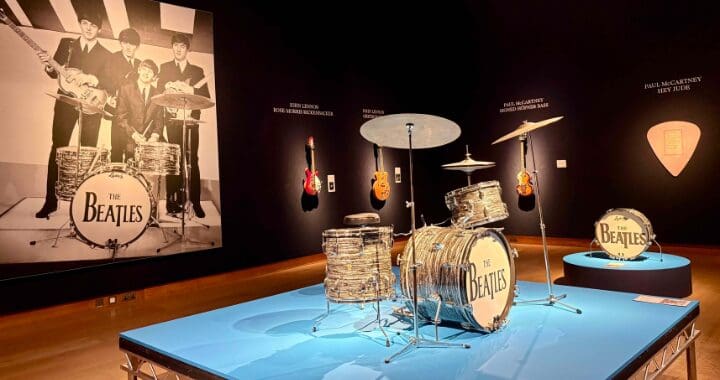
The market’s delightful illogic continues elsewhere. In the 2026 Irsay sale, the Beatles “Drop T” drumhead seen during their first Ed Sullivan Show appearance realised approximately £2.16 million; Ringo Starr’s first Ludwig kit made £1.79 million. The bit without drums sold for around £366,000 more than the drums.
Musically absurd, however when we look at the symbolism of the logo that introduced those four young lads from Liverpool to the world, its possibly the most important piece of drumming ephemera that has ever existed – I say possibly, because I have seen something that I think would top it – but I can’t talk about that.
That is ultimately why these prices cannot be explained by materials, utility or even rarity alone. Great musical instruments can be masterpieces of craft, and the very greatest sales occur when craft collides with memory. We do not simply collect the object. We collect the sound we associate with it, our memories, our visions – and maybe, just maybe a little bit of the magic that was created with it.
